Coming Around Again--a Real Miracle on 125th Street
| Miracle on 34th Street | |
|---|---|
 Theatrical release poster | |
| Directed by | George Seaton |
| Screenplay by | George Seaton |
| Story by | Valentine Davies |
| Produced past | William Perlberg |
| Starring |
|
| Cinematography |
|
| Edited by | Robert Simpson |
| Music by | Cyril Mockridge |
| Distributed by | 20th Century Trick |
| Release appointment |
|
| Running time | 96 minutes |
| State | United states of america |
| Language | English language |
| Budget | $630,000 |
| Box part | $two.seven million (Us rentals)[1] |
Phenomenon on 34th Street (initially released as The Big Heart in the United Kingdom)[ii] [3] [4] is a 1947 American Christmas comedy-drama film released past 20th Century Trick, written and directed by George Seaton and based on a story by Valentine Davies. It stars Maureen O'Hara, John Payne, Natalie Wood, and Edmund Gwenn. The story takes place between Thanksgiving Twenty-four hour period and Christmas Day in New York City, and focuses on the effect of a department store Santa Claus who claims to exist the real Santa. The moving picture has get a perennial Christmas favorite.
Phenomenon on 34th Street won iii Academy Awards: Gwenn for Best Actor in a Supporting Role, Valentine Davies for Best Writing, Original Story, and George Seaton for All-time Writing, Screenplay. The film was nominated for All-time Picture show, losing to Gentleman's Agreement. In 2005, the film was selected for preservation in the United states National Film Registry by the Library of Congress every bit being "culturally, historically or aesthetically significant". The Academy Film Archive preserved Miracle on 34th Street in 2009.[5]
Davies also wrote a curt novelization of the tale, which was published by Harcourt Brace simultaneously with the moving-picture show'due south release.
Plot [edit]
Kris Kringle is indignant to observe that the human assigned to play Santa in the annual Macy'south Thanksgiving Mean solar day Parade is intoxicated. When he complains to event manager Doris Walker, she persuades Kris to accept his place. He does so well that he is hired to play Santa at Macy'due south New York Metropolis store on 34th Street.
Ignoring instructions from the toy section head to recommend overstocked items to undecided shoppers, Kris directs one adult female to another store to fulfill her son's Christmas request. Impressed by Kris's honesty and helpfulness, she informs Julian that she volition now become a loyal Macy's client.
Chaser Fred Gailey, Doris's neighbor, takes the young divorcée's daughter Susan to meet Santa. Doris has raised her to not believe in fairy tales, just Susan is shaken later seeing Kris speak Dutch with a daughter who does not know English. Doris asks Kringle to tell Susan that he is non Santa, but he insists that he is.
Worried, Doris decides to fire him, but Kris has generated so much positive publicity and goodwill that the store's owner promises bonuses. To alleviate Doris'southward misgivings, Granville Sawyer is asked to administrate a "psychological evaluation" and recommends Kris' dismissal. Meanwhile Susan shows Kris a mag photo of her dream house and tells him she wants it for Christmas; reluctantly he promises to do his best.
In the company cafeteria, young employee Alfred tells Kris that Sawyer convinced him that he is unstable only because he is kind-hearted. Kris immediately goes to face up Sawyer, somewhen hitting him on the head with an umbrella. Sawyer exaggerates his pain to have Kris confined to Bellevue Hospital. Tricked into cooperating, and believing Doris to exist in on the deception, Kris deliberately fails his examination and is recommended for permanent commitment. However, Fred persuades Kris non to give up.
At a hearing earlier Judge Henry X. Harper, District Chaser Thomas Mara gets Kris to assert that he is Santa Claus and rests his instance, request Harper to rule that Santa does not be. In private, Harper's political adviser, Charlie Halloran, warns him that doing and so would be disastrous for his upcoming reelection bid. Harper buys time by hearing farther prove.
Fred calls Macy equally a witness and persuades him to acknowledge that he does believe in Santa. On leaving the stand up, Macy fires Sawyer. Next, Fred calls Mara's own young son, who testifies that his father told him that Santa was real. Mara has to concede the point, but goes on to demand that Fred evidence that Kris is "the ane and only" Santa Claus on the basis of some competent authority by the following day.
Meanwhile, Susan writes Kris a letter of the alphabet to cheer him up, which Doris as well signs. When a New York Post Office mail sorter sees Susan's letter, which is addressed to Kris at the New York courthouse, he suggests delivering all of the dead letters addressed to Santa Claus to Kris. As court resumes, Fred is told of the commitment of mailbags to the courthouse; he argues that the Post Office—a branch of the U.South. federal government—has acknowledged that Kris is the ane and only Santa Claus by delivering the messages. When the guess insists on seeing them, Fred has them dump bag after bag on Harper's desk-bound. Half concealed behind them, Harper dismisses the case.
On Christmas morning, Susan loses organized religion in Kris when he admits he was non able to become her the firm she wanted. However, after Kris offers Fred and Doris a route home that avoids traffic, Susan sees her dream house with a "For Sale" sign in front. Demanding that Fred stop the car, she joyfully runs into the firm, exclaiming "Mr. Kringle IS Santa Claus!" Fred learns that Doris had encouraged Susan to accept organized religion and suggests they buy the house. He and then boasts that he must be a great lawyer since he proved an eccentric old man was Santa. However, when he and Doris spot a pikestaff in the house that looks just like Kris's, he is not so sure.
Cast [edit]
Production [edit]
The original trailer for Phenomenon on 34th Street omitted any mention of its Christmas themes.
Phenomenon on 34th Street was shot on location in New York City, with the Macy's Thanksgiving Parade sequences filmed live while the 1946 parade was happening.[vi] "It was a mad scramble to become all the shots we needed, and we got to practice each scene only once," Maureen O'Hara recalled in her memoir. "It was bitterly cold that 24-hour interval, and Edmund and I envied Natalie (Wood) and John Payne, who were watching the parade from a window."[6]
Although the film is ready during the Christmas season, studio head Darryl F. Zanuck insisted that it exist released in May, arguing that more people go to the movies in warmer weather.[vii] The studio rushed to promote it while keeping its Christmas setting a secret. Fox's promotional trailer depicted a fictional producer roaming the studio backlot and encountering such stars equally Rex Harrison, Anne Baxter, Peggy Ann Garner, and Dick Haymes extolling the virtues of the moving-picture show. In addition, the pic posters prominently featured O'Hara and Payne, with Gwenn's grapheme kept in the background. The flick opened in New York City at the Roxy Theatre on June 4, 1947.[8] By dissimilarity, modern home video packaging has Gwenn and Wood dominating the imagery, with the DVD release having Kringle in his Santa Claus costume.
O'Hara was initially reluctant to accept the role, having recently moved dorsum to mail-state of war Ireland. She immediately inverse her mind after reading the script[9] and came back to the United States for the movie.
Arthur Jacobson, assistant director, filmed the Macy's Parade on Thanksgiving morn with 9 cameras simultaneously. He said he "plunked actors Edmund Gwenn and Natalie Forest in the section store deli line during a weekday dejeuner-rush". When Maureen O'Hara requested a special police escort for a Christmas shopping spree through Macy's he said "I know New Yorkers. They aren't going to pay whatsoever attention to you. And don't wear a bandanna around your caput or dark glasses. Just be normal."[10]
The Christmas window displays seen in the movie were originally fabricated by Steiff for Macy's. Macy's later sold the window displays to FAO Schwarz in New York. FAO Schwarz then sold the windows to the BMO Harris Bank of Milwaukee, Wisconsin, where they are on display every Dec in the banking company's vestibule on North Water Street.[ commendation needed ]
The house shown at the end of the film is a 1703 square foot unmarried family home built in 1943 at 24 Derby Road, Port Washington, New York. The home looks practically the same as information technology did in 1947, except that the roof line has been altered past the addition of a window.[ citation needed ]
Rowland Hussey Macy, called R. H. Macy in the picture show, died seventy years prior to the film (in 1877),[eleven] and the Macy family had sold its ownership of the company in 1895.
Throughout the process of getting this script accustomed past the PCA, the motion-picture show underwent multiple different title changes. Starting as My Middle Tells Me and so progressing into The Large Center, It'southward Only Human, Meet Me at Dawn, and finally ended with the proper name Phenomenon on 34th Street. These title changes all happened within a four-month time menstruum. These championship changes occurred while the filmmakers were fixing whatsoever other discrepancies that the PCA required them to prepare before the production of the film could brainstorm.[12]
Reaction [edit]
Disquisitional reception [edit]
![[icon]](https://upload.wikimedia.org/wikipedia/commons/thumb/1/1c/Wiki_letter_w_cropped.svg/20px-Wiki_letter_w_cropped.svg.png) | This department needs expansion. You can help by calculation to it. (Nov 2014) |
Miracle on 34th Street generally received positive reviews from critics. Bosley Crowther of The New York Times said: "For all those blasé skeptics who practice not believe in Santa Claus—and likewise for all those natives who have grown cynical about New York—merely nearly especially for all those patrons who have grown weary of the monotonies of the screen, permit us heartily recommend the Roxy'south new picture, Miracle on 34th Street. As a thing of fact, permit's get further: permit's grab its spirit and heartily proclaim that it is the freshest little picture in a long fourth dimension, and maybe even the best comedy of this year."[thirteen] Today, it is considered by many to be one of the all-time films of 1947.[14] [fifteen] On Rotten Tomatoes the film has a 96% "Certified Fresh" rating based on reviews from 48 critics. The site's consensus states: "Irrefutable proof that gentle sentimentalism can be the chief ingredient in a wonderful picture, Phenomenon on 34th Street delivers a warm holiday message without resorting to treacle."[sixteen]
The Catholic Legion of Decency gave the film a "B", "morally objectionable in role" rating. This was mainly due to the fact that O'Hara portrayed a divorcée in the picture show.[17]
Accolades [edit]
The film won Academy Awards for Best Actor in a Supporting Role (Edmund Gwenn), Best Writing, Original Story (Valentine Davies) and Best Writing, Screenplay. Information technology was also nominated for Best Film, losing to Admirer'southward Agreement.
It was ranked ninth by the American Film Institute on 100 Years... 100 Cheers, a list of America's nearly inspiring films.[eighteen] Miracle on 34th Street was listed as the fifth best film in the fantasy genre in the American Film Constitute'south "X tiptop Ten" lists in 2008.[xix] [twenty]
In 2005, Miracle on 34th Street was selected for preservation in the United States National Motion picture Registry past the Library of Congress as being "culturally, historically, or aesthetically significant".[21] [22]
American Film Institute Lists
- AFI'due south 100 Years...100 Movies – Nominated[23]
- AFI's 100 Years of Film Scores – Nominated[24]
- AFI's 100 Years...100 Cheers – #9
- AFI'southward 100 Years...100 Movies (tenth Anniversary Edition) – Nominated[25]
- AFI'south 10 Meridian 10 – #5 Fantasy Motion-picture show
Dwelling house media and colorization [edit]
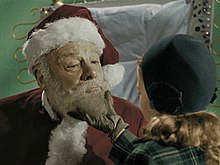
Miracle on 34th Street was first released on VHS and LaserDisc in 1987.
In 1985, information technology became ane of the first full-length black and white films to be colorized.[26] The 4½-month process was carried out by Color Systems Applied science, Inc.[27] In 1993, this version was released on VHS and LaserDisc, and was followed four years later by a "50th Anniversary Edition" on both formats, remastered by THX.
The first DVD release was in October 1999, featuring the B&Westward version aslope the original theatrical trailer and a TV spot. In November 2006, it was re-released as a two-disc "Special Edition" DVD, with disc i containing an "all new colorized version" carried out by Legend Films. The second disc had the original black-and-white version and numerous extras, including The 20th Century Fox Hour 'due south 1955 TV remake. Both discs also included a full-length audio commentary by Maureen O'Hara. The B&W disc has since been re-released several times, including in a pairing with the 1994 remake.
In October 2009, 20th Century Fox released the B&W version on Blu-ray with all previous extras, bar the TV remake.[28]
In 2017, the film was restored in 4K resolution; and then far this version is only available via DCP.[29]
Remake [edit]
A 1994 feature film starred Richard Attenborough, Elizabeth Perkins, Dylan McDermott, J. T. Walsh, Timothy Shea, James Remar, Jane Leeves, Simon Jones, William Windom and Mara Wilson. It was adapted past John Hughes from the Seaton script, and directed by Les Mayfield. Due to Macy's refusal to requite permission to apply its name, information technology was replaced past the fictitious "Cole'due south". "We feel the original stands on its ain and could non exist improved upon," said Laura Melillo, a spokeswoman for Macy'southward. Gimbels no longer existed by 1994 so its proper name was replaced by the name of the fictional "Shopper'due south Limited". Alvin Greenman (Alfred in the original version) played a doorman. The 1994 remake of the film had a more than serious tone than the original 1947 film had and a big portion of the plot was rewritten, although the majority of both the plot and the characters remained intact. The 1994 moving picture also added a subtext which described concerns about religious faith.
In other media [edit]
There are numerous remakes of the movie, as well as a Broadway musical.
Radio [edit]
Lux Radio Theatre aired a one-hour adaptation of the pic on three occasions: on Dec 22, 1947, which starred the original bandage including Natalie Woods;[xxx] on December xx, 1948, without Natalie Wood's participation;[31] and on December 21, 1954.[32] There were also two broadcasts on Screen Directors Playhouse: as a half-hour play on December 23, 1949;[33] and then as a one-hour play on December 21, 1950.[34] All of these adaptations had Edmund Gwenn reprising his screen role.
Theatre [edit]
A 1963 Broadway musical version, entitled Here's Honey, was written past Meredith Willson.
The novella was adapted into a stage play past Will Severin, Patricia Di Benedetto Snyder and John Vreeke in 2000. It is a favorite in many community and regional theaters during the Christmas flavor.[35] The characters' names are those used in the novella, and the phase setting is distinctly late 1940s. Production rights are held past Samuel French, Inc.[36]
Goggle box [edit]
A 1955 one-hour television adaptation of the movie starred Thomas Mitchell every bit Kris, Macdonald Carey as Fred, Teresa Wright as Doris, and Sandy Descher as Susan. This version did non show the drunken Santa at all. Titled "The Miracle on 34th Street", it originally aired every bit an episode of The 20th Century Fox 60 minutes. Information technology was later re-run every bit "Encounter Mr. Kringle".
Ed Wynn played Kris in a 1959 goggle box adaptation of the movie. Also featured was Orson Edible bean. It was broadcast live and in color on NBC the day after Thanksgiving. NBC made a kinescope of the programme, probably for broadcasting opening nighttime on the West Coast. The copy was in a large drove of kinescopes donated by NBC to the Library of Congress and later unearthed past Richard Finegan, who reported his experiences in the December 2005 issue of Classic Images.
A 1973 goggle box version featured Jane Alexander, David Hartman, Roddy McDowall, Sebastian Cabot as Kris (without his natural bristles; he was forced to shave and wear a fake beard for the function), Suzanne Davidson, Jim Backus, David Doyle and Tom Bosley. It was adapted by Jeb Rosebrook from the George Seaton screenplay, and directed past Fielder Melt. Mrs. Walker's outset proper name is changed to Karen in this version. This would prove to be the final version in which the section store was actually Macy's. David Doyle, who played R. H. Macy in this version, had played Mr. Sawyer in the original Broadway bandage of Here's Honey 10 years earlier.
Puppets [edit]
In 2012, the flagship Macy's Department Shop at Herald Foursquare in New York City featured a 30-minute boob version of the story within its Santaland display, featuring the voice talents of Broadway stars Brian Stokes Mitchell and Victoria Clark.[37]
Appearances [edit]
A short clip of the film was seen on the kitchen television screen in Home Alone (a 1990 Christmas film released by Fox) and also the ending was seen in the den television screen in the 1996 film The Preacher's Wife.
Run into also [edit]
- Trial film
- List of Christmas films
- Santa Claus in flick
References [edit]
- ^ "Top Grossers of 1947", Diversity, 7 Jan 1948, p. 63
- ^ BFI: Phenomenon on 34th Street Archived September xv, 2015, at the Wayback Automobile Retrieved Dec 22, 2012
- ^ "Miracle on 34th Street, Release Info, Likewise Known As". Internet Movie Database . Retrieved December 21, 2017.
- ^ "The Big Heart Poster". Movie Poster Studio . Retrieved December 21, 2017.
- ^ "Preserved Projects". Academy Film Archive.
- ^ a b O'Hara, M.; Nicoletti, J. (2005). Tis Herself: An Autobiography. Non fiction May 2012. Simon & Schuster. p. 116. ISBN978-0-7432-6916-2 . Retrieved December 9, 2019.
- ^ "A Weird Thing You Didn't Know About Your Favorite Classic Christmas Films". HuffPost . Retrieved Dec ix, 2019.
- ^ Dark-brown, Gene (1995). Movie Time: A Chronology of Hollywood and the Movie Industry from Its Beginnings to the Nowadays . New York, NY: Macmillan. p. 186. ISBN0-02-860429-vi.
- ^ O'Hara, Maureen; John Nicoletti (2005). 'Tis herself: a memoir. London: Pocket. p. 139. ISBN978-0-7434-9535-6.
- ^ "Arthur Jacobson - New York to Hollywood". DGA Quarterly Mag. 2011. Retrieved March 31, 2020.
- ^ "Rowland Hussey Macy". Detect a Grave. June iii, 1998. Retrieved August 22, 2017.
- ^ "CONTENTdm". digitalcollections.oscars.org . Retrieved October 21, 2021.
- ^ Crowther, Bosley (June five, 1947). "Flick Review: ' Miracle on 34th Street,' With Edmund Gwenn in the Function of Santa Claus, at Roxy -- 'Spider web' at Loew's Criterion". The New York Times. Archived from the original on August 23, 2017. Retrieved Baronial 22, 2017.
- ^ "Greatest Films of 1947". Filmsite.org. Retrieved May 31, 2010.
- ^ "The Best Movies of 1947 by Rank". Films101.com. Retrieved May 31, 2010.
- ^ "Miracle on 34th Street". Rotten Tomatoes. Fandango. Retrieved Oct vii, 2021.
- ^ Catcher, Jessica (December 12, 2014). "12 Crawly Facts You Didn't Know Almost The Original Phenomenon On 34th Street". ViralNova. Archived from the original on May 27, 2015. Retrieved May 27, 2015.
- ^ "AFI'due south 100 Years...100 Cheers". American Picture show Found. 2006. Retrieved August 22, 2017.
- ^ "AFI Crowns Superlative ten Films in 10 Classic Genres". ComingSoon.internet. June 17, 2008. Retrieved June 18, 2008.
- ^ "Acme 10 Fantasy". American Film Constitute. Retrieved June 18, 2008.
- ^ "Miracle on 34th Street". On Location Tours. Archived from the original on January 15, 2010. Retrieved Baronial 22, 2017.
- ^ "Miracle on 34th Street (1947): Awards". IMDb. Retrieved Baronial 22, 2017.
- ^ "AFI's 100 Years...100 Movies Nominees" (PDF). AFI. 2002. Archived from the original (PDF) on Oct 26, 2013. Retrieved November 26, 2011.
- ^ "AFI'south 100 Years of Motion-picture show Scores Nominees: Official Ballot" (PDF). AFI. September 23, 2005. Archived from the original (PDF) on Nov vi, 2013. Retrieved August 22, 2017.
- ^ "AFI's 100 Years...100 Movies (10th Anniversary Edition) Ballot" (PDF). AFI. 2007.
- ^ "Phenomenon on 34th Street (1947)". Turner Classic Movies . Retrieved January 26, 2018.
- ^ Nitrate Won't Wait: A History of Film Preservation in the U.s. (2000) by Anthony Slide, p. 125.
- ^ "Phenomenon on 34th Street Blu-ray". Blu-ray.com. Retrieved May 31, 2010.
- ^ "Restored Christmas Classics". Park Circus.
- ^ "Arion Chorus Sings at 10; Yule Music Dominates Air". Youngstown Vindicator (Ohio). December 22, 1947. p. fifteen. Retrieved June ane, 2021.
- ^ "MIRACLE ON 34TH ST. on Lux Theatre Tonite (KSL advert)". The Deseret News. December twenty, 1948. p. F-two. Retrieved June 1, 2021.
- ^ "Radio This evening". Youngstown Vindicator (Ohio). December 21, 1954. p. 39. Retrieved June ane, 2021.
- ^ "Friday Selections". Toledo Bract (Ohio). December 23, 1949. p. iv (Peach Section). Retrieved June 1, 2021.
- ^ "Thursday Selections". Toledo Blade (Ohio). Dec 21, 1950. p. 4 (Peach Section). Retrieved June one, 2021.
- ^ "Rancho Cucamonga Customs Theatre Presents Miracle on 34th Street". Lewis Family Playhouse. Retrieved August 22, 2017.
- ^ Snyder, Patricia Di Benedetto; Severin, Volition; Vreeke, John (2000). Miracle on 34th Street: A Play from the Novel by Valentine Davies. Samuel French, Inc. ISBN978-0573628924.
- ^ "Miracle on 34th Street at Macy's Boob Theatre". TimeOut. TimeOut. Retrieved December 25, 2020.

External links [edit]

Streaming sound
- Miracle on 34th Street on Lux Radio Theater: December 22, 1947
- Miracle on 34th Street on Screen Directors Playhouse: December 23, 1949
- Phenomenon on 34th Street on Screen Directors Playhouse: December 21, 1950
- Miracle on 34th Street on Lux Radio Theater: December 21, 1954
deanhispeauncer80.blogspot.com
Source: https://en.wikipedia.org/wiki/Miracle_on_34th_Street
0 Response to "Coming Around Again--a Real Miracle on 125th Street"
Publicar un comentario